This is a post to present one method to inverse the bit pattern of an input number, the bitwise not operation on a bit pattern. I am presenting one method which i figured out.
Continue reading “Bash Script : Bitwise Not Operation in bash”
Simpson’s 1/3rd Rule
A brief introduction to the Simpson’s 1/3rd rule and a uniform interval Composite Simpson’s 1/3rd Rule implementation.
Continue reading “Simpson’s 1/3rd Rule”
Bash Script: Generating Primes within Range
Objective
Generating prime numbers within a range using bash script. The technique used in this implementation to generate the prime numbers is still the good old divide and check method, but with some tweaks attempting to make the execution a bit better.
Approach
The core method is, we check if an integer p is prime by:
- Dividing with integers which are not multiples of 2’s and 3’s
- Dividing with integers upto floor ( sqrt ( p ) )
The integer p itself is needed to be not divisible by 2 or 3 or both.
Read more to get the bash script
Trapezoidal Rule
A brief introduction to the Trapezoidal rule and a uniform interval Composite Trapezoidal Rule implementation.
Continue reading “Trapezoidal Rule”
Balanced Parenthesis Check
Objective
To check if an entered string containing nested parenthesis are balanced and valid. This write-up presents a function with which a string is checked for balanced parenthesis.
Continue reading “Balanced Parenthesis Check”
GCD of n integers
Greatest Common Divisor
Let a and b be integers, not both zero. The largest integer d such that d exactly divides both a and b is called the greatest common divisor of a and b . The GCD of the two integers a and b is denoted as gcd(a, b)
Continue reading “GCD of n integers”
awk to the rescue
Some days back I got a collection of 100 Greatest Piano Works cd collection. The first thing I did was to rip the CD in flac and preserve a lossless copy of the disks. Then I converted those to ogg files (with oggenc ) so that I could take it in my iPod and listen at any time. The problem occurred at the final moment when I realized that the file names were really long and which would be very difficult to scan through my iPod (with Rockbox). The file name was in this format : %n – %a – %t.ogg for example : For example :
“17 – Robert Schumann (1810-1856) – THE DAVIDSBÜNDLER DANCES, 18 CHARACTERISTIC PIECES, OP. 6: XIV. Zart und singend – Dolce e cantando.ogg” . The western classical musics this combination is very long most almost all the tracks, and these files with huge file names and lot of files having ‘:’ in the name being refused to copied directly. So I needed to truncate or rename the 100 files in a way so that they are identifiable and also truncated to short names.
I decided to keep only the track name and composers names (%n – %a fields), by renaming the files with some batch file renaming process. Continue reading “awk to the rescue”
Sieve of Eratosthenes : A basic implementation
The Sieve of Eratosthenes is a process to find all primes not exceeding a specific positive integer. The process is simple. First all the numbers within the range is populated in a list.The process strikes out all the numbers in the list which are multiple of some previous number. This strike-out process starts with the integer 2, thus first all the multiple of 2 upto the limit n are striked out. Note that the number 2 itself is not striked out, because it is not a multiple of any integer lesser than it (except 1). Next the just following unstriked integer is selected, which is in this case 3, and then all the multiples of 3 are striked out from the like, and again the next unstriked out integer is selected and the process continues until no such integer remains in the list which is unstriked and a multiple of some integer lesser that it. Note that the next integer to strike out after the ith unstriked integer is i * i , as all the multiples of i less than i are striked in the previous passes. At the end if the process only those numbers will be still unstriked in the list which are not a multiple of some other integer lesser that it, thus only the prime numbers will remain unstriked in the list. At the end of the process the list can be rescanned and the unstriked integers could be found.
Read more about Sieve of Eratosthenes here: http://en.wikipedia.org/wiki/Sieve_of_Eratosthenes
Read the complete implementation
Code Quality Measurement Unit : WTF / minuite
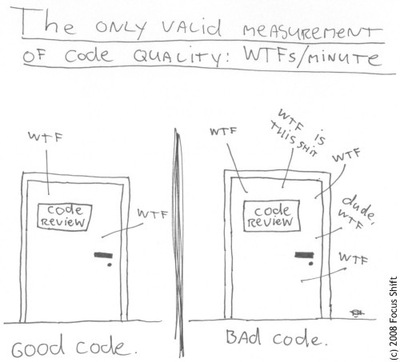
The only Code Quality Measurement Unit
Continue reading “Code Quality Measurement Unit : WTF / minuite”
wcat : A GNU cat implementation
Everybody has used the GNU or UNIX cat program in the command line. It is used to concatenate files and dump it into the standard output, or can simply be redirected to another file. Long ago i started to write my own version of the cat program. I have implemented each and every function which cat supports, and also made it look identical, except some messages. Although this is not a cat clone, and has no connection with the source code of GNU cat. This code was made by inspecting the output behaviour of GNU cat. This is named wcat. I started this because this was the most simple code to write and was intended for the Whitix OS project run by Mathew (http://www.whitix.org/). This is a very good OS development project for the beginners to start with. I could not at present actively participate in this project because of the time limitations here at my end.
Check out the code
 Phoxis